
Embedded C & Microcontroller Fundamentals Course 2025 – Build Smarter Firmware
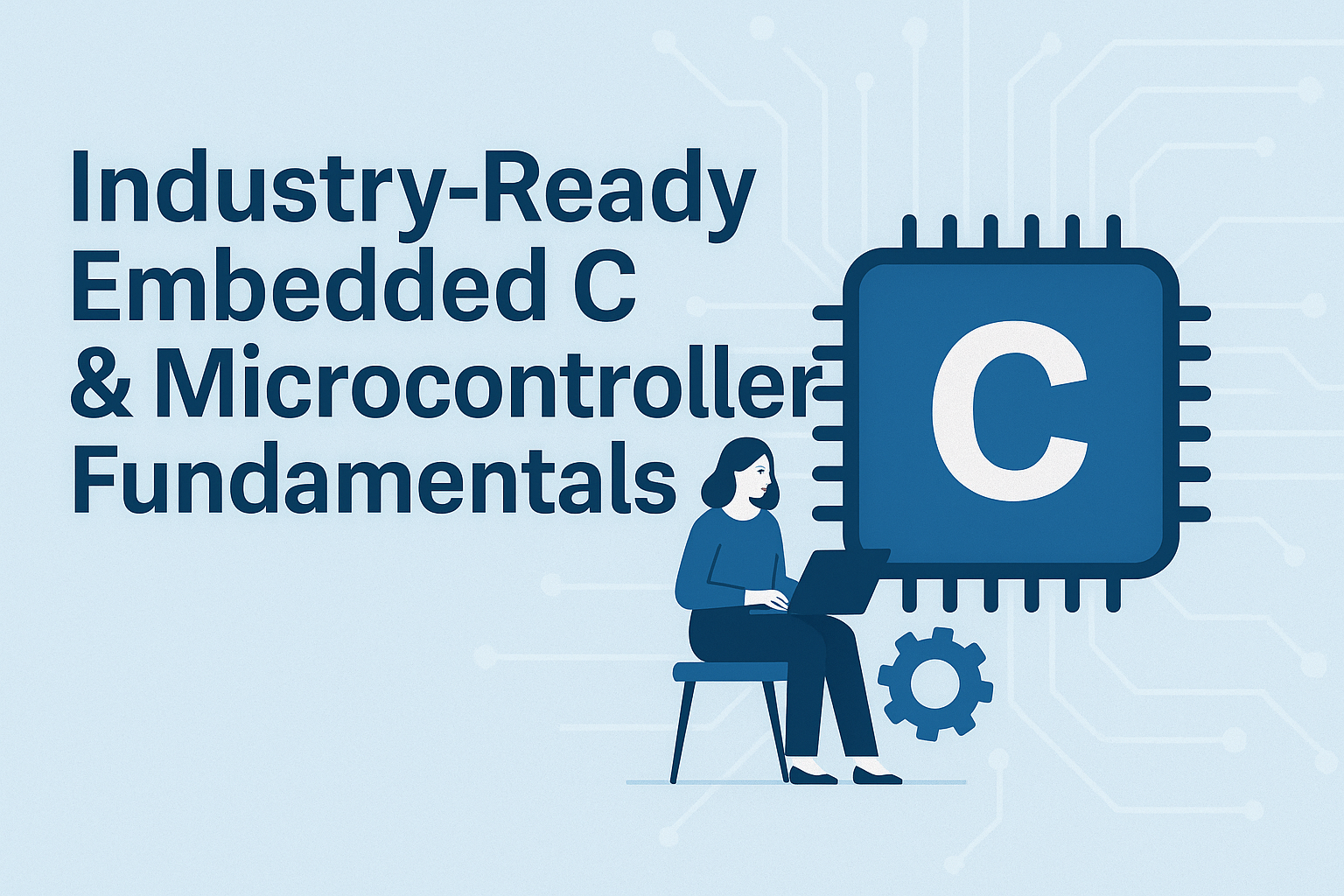
Master Embedded C & Microcontroller Fundamentals Course—learn ARM Cortex-M, bare-metal programming, GPIO, timers, interrupts, and build industry-ready projects.
Overview
Course Overview
The Industry-Ready Embedded C & Microcontroller Fundamentals Course equips learners with the core skills every embedded engineer must master: bare-metal programming, ARM Cortex-M architecture, and direct control of microcontroller peripherals. Designed with industry demand in mind, the program moves step by step from foundational concepts to real-world project design—ensuring participants graduate with both strong theoretical foundations and hands-on experience that hiring teams value.
Course Description
Embedded systems power everything from smart home gadgets and wearable electronics to automotive ECUs, robotics, aerospace systems, and industrial controllers. This course takes you deep into the ARM Cortex-M ecosystem (STM32, RP2040, NXP LPC), guiding you through Embedded C programming and the essentials of microcontroller operation at the hardware level.
Across 10 structured modules, you’ll move from the basics of GPIO and timers to advanced topics like ADC/DAC, communication protocols (UART, SPI, I²C), low-power design, and watchdogs. Each module is paired with industry-style labs, coding challenges, and mini-projects, ensuring you not only learn the concepts but also apply them in real-world scenarios.
The program concludes with a Capstone Project—a bare-metal Smart Home Controller that integrates multiple peripherals. You’ll apply coding standards such as MISRA-C, use Git version control, and produce documentation and testing evidence that reflect true industry workflows. By the end, you will have a portfolio-ready project that demonstrates your ability to build reliable embedded firmware from the ground up.
What You’ll Learn
-
Master Embedded C programming in a microcontroller context.
-
Understand the ARM Cortex-M core architecture and the complete toolchain flow.
-
Configure and program GPIOs, timers, ADC/DAC, and communication interfaces.
-
Implement interrupt-driven design for responsive, event-based systems.
-
Apply low-power modes, watchdogs, and memory management in real-world projects.
-
Deliver a capstone project demonstrating end-to-end integration of peripherals.
-
Adopt industry practices like MISRA-C guidelines, code reviews, and version control.
Course Outcomes
By the end of this Embedded C & Microcontroller Fundamentals Course, you will be able to:
-
Write, compile, and debug bare-metal firmware on ARM Cortex-M devices.
-
Configure and integrate core microcontroller peripherals (GPIO, timers, interrupts, ADC/DAC, UART, SPI, I²C).
-
Build and document complete embedded applications ready for deployment.
-
Demonstrate best practices in embedded software engineering and system design.
Who This Course Is For
-
Students, hobbyists, or professionals aiming to break into embedded systems.
-
Junior engineers looking to transition into industry-ready roles.
-
Firmware developers seeking to strengthen their bare-metal programming foundation.
-
Anyone who wants hands-on training in ARM Cortex-M development for IoT, robotics, and automotive projects.
Industry Need
In the embedded domain, every engineer is expected to know bare-metal programming—not just high-level, library-based development. The ability to directly configure registers, write startup code, and manage resources at the hardware level is what distinguishes true embedded engineers from application programmers.
This course ensures you can confidently:
-
Work without heavy abstractions or vendor-specific HALs.
-
Optimize for performance, reliability, and low power.
-
Design firmware that scales from prototyping to production.
As industries from IoT to aerospace demand engineers who understand what happens at the silicon level, mastering these fundamentals will make you stand out in interviews, project teams, and long-term career growth.
Why This Course Stands Out
-
Step-by-step structure: from fundamentals to advanced peripherals.
-
Hands-on labs in every module, not just theory.
-
Capstone project aligned with industry workflows.
-
Portfolio-ready deliverables to showcase to employers.
-
Focus on industry standards (MISRA-C, Git, review checklists).
Frequently Asked Questions (FAQ)
Q: Do I need prior experience before joining this course?
No prior embedded systems experience is required. If you are familiar with basic C programming, this course will guide you step by step into the world of microcontrollers.
Q: Which boards are supported in this course?
We recommend STM32F4, STM32F7, or STM32H7 boards, but you can also use RP2040 or NXP LPC series microcontrollers. All labs and projects are adaptable to common ARM Cortex-M boards.
Q: Is this course suitable for beginners?
Yes. The course starts with fundamentals like GPIO and timers before moving to advanced topics such as interrupts, communication protocols, and power management. Beginners can follow along, while professionals will benefit from the structured, industry-ready approach.
Q: Will I build real projects?
Absolutely. Each module includes labs and mini-projects, and you’ll complete a Capstone Project—a Smart Home Controller integrating multiple peripherals. This portfolio piece demonstrates your industry readiness.
Q: How is this course different from online tutorials?
Unlike tutorials that focus only on demos, this course emphasizes industry practices like MISRA-C coding standards, code reviews, documentation, and Git version control—skills employers expect.
Q: What industries can I target after completing this course?
The skills you gain are applicable in IoT, robotics, consumer electronics, automotive, and aerospace—anywhere embedded systems are used.
DoFollow External Links
Add authoritative references:
Suggested Internal Link Texts
-
“Start with Embedded C & STM32 Fundamentals before diving into advanced RTOS concepts.”
Curriculum
- 10 Sections
- 42 Lessons
- 10 Weeks
- Foundations of Embedded Systems5
- Embedded C Programming for Microcontrollers5
- ARM Cortex-M Core Basics5
- GPIO (Digital I/O)4
- Timers & Counters4
- Interrupts & Event-Driven Programming4
- Analog Interfaces (ADC & DAC)4
- Communication Protocols (Bare-metal & Driver Level)4
- Industry Applications & Integration4
- Capstone Project (Industry Simulation)3
Instructor

You May Like
FreeRTOS & Real-Time Systems (Pro Course 2025) – Fast & Reliable Firmware
Learn FreeRTOS & Real-Time Systems in this industry-ready course. From tasks, queues, semaphores, and watchdogs to tickless idle, trace tools, and IoT projects—you’ll build rock-solid,...
STM32 from Zero to Hero Embedded Systems Course 2025: Industry-Ready Training
STM32 from Zero to Hero Embedded Systems Course 2025: Industry-Ready Training Course Overview The STM32 from Zero to Hero: Industry-Ready Embedded Systems Course is designed...
Course Features
- Lectures 42
- Quiz 0
- Duration 10 weeks
- Skill level Beginner
- Language English
- Students 0
- Certificate No
- Assessments Yes