
STM32 from Zero to Hero Embedded Systems Course 2025: Industry-Ready Training
STM32 from Zero to Hero Embedded Systems Course 2025: Industry-Ready Training Course Overview The STM32 from Zero to Hero: Industry-Ready Embedded Systems Course is designed to take you from an absolute beginner to an industry-ready embedded systems developer using the …
Overview
STM32 from Zero to Hero Embedded Systems Course 2025: Industry-Ready Training
Course Overview
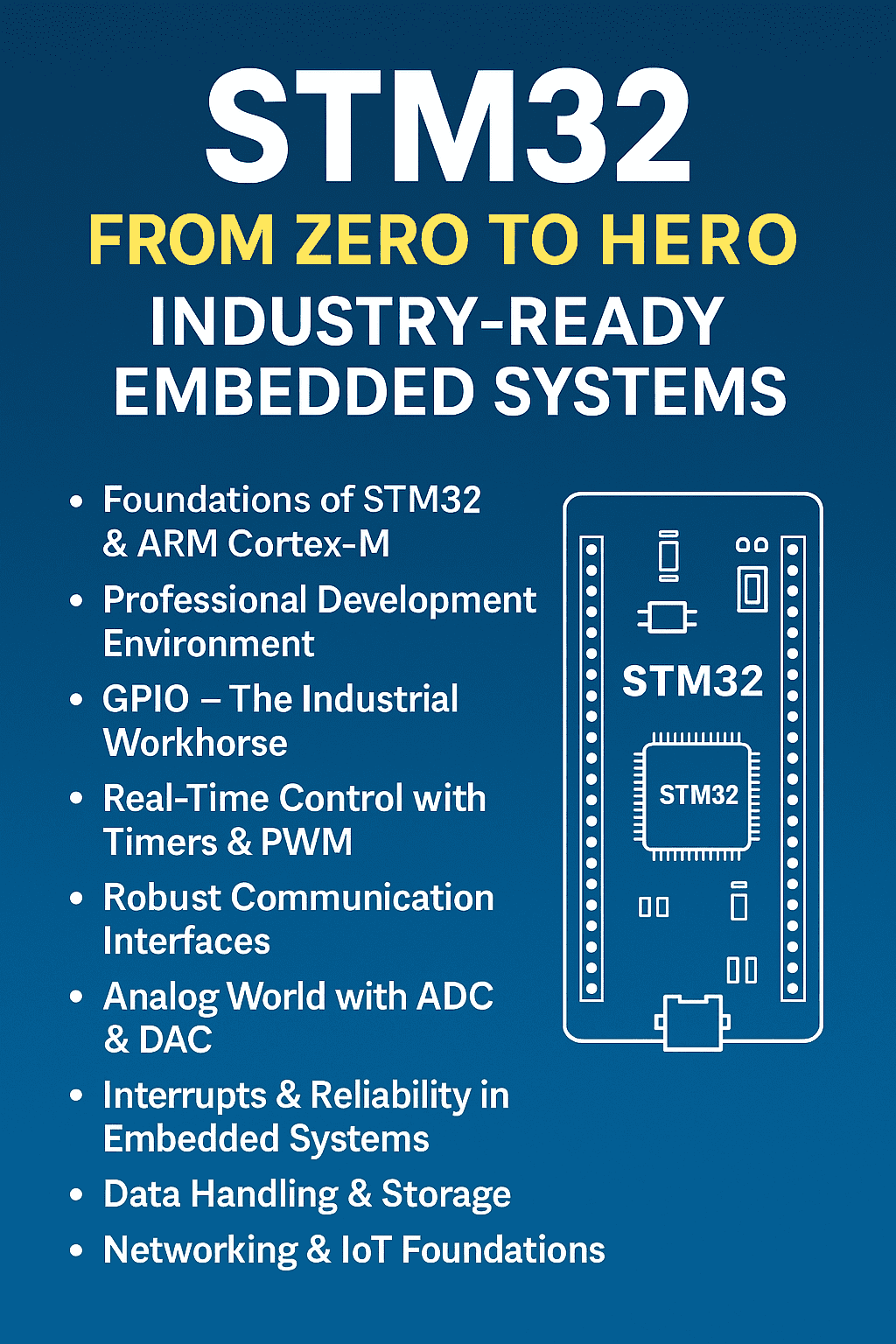
The STM32 from Zero to Hero: Industry-Ready Embedded Systems Course is designed to take you from an absolute beginner to an industry-ready embedded systems developer using the powerful STM32 ARM Cortex-M microcontrollers. Unlike typical tutorials that stop at blinking LEDs or simple GPIO demos, this program is built with a practical, industry-first approach, ensuring every module connects directly to real-world applications.
You’ll start by understanding the STM32 ecosystem and setting up a professional development environment. Then, step by step, you’ll dive into GPIO, timers, PWM, UART, I²C, SPI, ADC/DAC, interrupts, low-power modes, watchdogs, and CRC. As you progress, you’ll build hands-on projects such as sensor dashboards, motor controllers, data loggers, and IoT-enabled devices.
By the end of the course, you won’t just know how to write Embedded C for STM32—you’ll also be confident in applying industry practices such as MISRA-C coding standards, HAL vs. LL driver selection, file systems, IoT protocols, and secure OTA updates.
👉 If you are completely new to embedded programming, you may also want to check out our Embedded C & Microcontroller Fundamentals Course before starting, as it provides the essential foundations.
What You’ll Learn
-
Fundamentals of STM32 and ARM Cortex-M architecture
-
Professional workflows with STM32CubeIDE & CubeMX
-
GPIO control, external interrupts, and fail-safe design
-
Real-time control using timers & PWM (motors, actuators, LEDs)
-
Serial communications (UART, SPI, I²C) for industrial devices
-
Sensor data acquisition with ADC & DAC
-
Reliable design with watchdogs, CRC, and low-power modes
-
File system integration with FATFS for SD card logging
-
IoT networking with Wi-Fi & MQTT protocols
-
Security concepts: bootloaders, OTA updates, and coding standards
Who This Course Is For
-
Students & Beginners starting their embedded systems journey
-
Electronics hobbyists & makers building STM32 projects
-
Engineers & professionals transitioning into embedded/IoT careers
-
Project builders & researchers creating smart devices, IoT nodes, or robotics systems
Industry-Ready Projects You’ll Build
-
Smart Button & Indicator System (GPIO + debouncing logic)
-
PWM Motor Speed Controller (timers + PWM-based actuator control)
-
Multi-Sensor Dashboard with OLED Display (I²C + SPI integration)
-
Temperature Threshold Control System (ADC + UART for alerts)
-
Energy-Efficient Data Logger (SD card + watchdogs + sleep modes)
-
IoT Sensor Node publishing data via Wi-Fi + MQTT
-
Capstone Project: An IoT-Ready Smart Device integrating sensing, control, storage, and connectivity features
These projects aren’t just demos—they’re miniature industry case studies, preparing you for roles in IoT, automotive, robotics, and consumer electronics.
Why Take This Course?
-
Structured roadmap: from absolute beginner → industry-ready engineer
-
Hands-on projects in every module, not just theory
-
Industry practices included (MISRA-C, HAL vs. LL drivers, version control)
-
Direct preparation for IoT, embedded systems, and automotive jobs
-
Learn STM32CubeIDE, CubeMX, HAL & LL drivers—the exact tools used in professional environments
Career Benefits
Completing this course means you’ll have portfolio-ready STM32 projects that employers recognize. You’ll know how to:
-
Move from superloop designs to structured, interrupt-driven firmware
-
Apply low-power techniques crucial for IoT devices
-
Build firmware with robust fault tolerance (CRC, watchdogs)
-
Document your work in a way that mirrors industry workflows
This prepares you not only for junior embedded developer roles but also for IoT-focused positions where STM32 is a go-to microcontroller.
👉 Want to level up further? Pair this course with our FreeRTOS & Real-Time Systems Course to move beyond superloops into deterministic, multitasking firmware—a skillset highly demanded in robotics and automotive industries.
Frequently Asked Questions (FAQ)
Q: Do I need prior experience with STM32?
No. This course starts from zero. If you know basic C programming, you’ll be able to follow along.
Q: Which STM32 board should I use?
We recommend STM32F4 series boards (like STM32F407/411). They are affordable, widely supported, and compatible with all course labs.
Q: Will I learn debugging techniques?
Yes. You’ll explore debugging with STM32CubeIDE and use logic analyzers or oscilloscopes where applicable.
Q: Are these projects industry-relevant?
Absolutely. Each project reflects real embedded workflows such as motor control, data logging, and IoT connectivity.
Q: Can I apply these skills outside STM32?
Yes. The ARM Cortex-M fundamentals you’ll learn apply to other popular microcontrollers such as NXP LPC and RP2040.
External References (DoFollow)
Suggested Internal Link Texts
-
“Start with Embedded C & STM32 Fundamentals before diving into advanced RTOS concepts.”
Curriculum
- 11 Sections
- 44 Lessons
- Lifetime
- Foundations of STM32 & ARM Cortex-M4
- Development Environment Setup3
- GPIO – The Industrial Workhorse4
- Real-Time Control with Timers & PWM4
- Robust Communication Interfaces4
- Analog World with ADC & DAC4
- Interrupts & Reliability in Embedded Systems4
- Data Handling & Storage4
- Networking & IoT Foundations4
- Security, Updates & Industry Practices4
- Capstone Project: Industry-Style Smart IoT Device5
Instructor

Course Features
- Lectures 44
- Quiz 0
- Duration Lifetime access
- Skill level Beginner
- Language English
- Students 2
- Certificate No
- Assessments Yes